
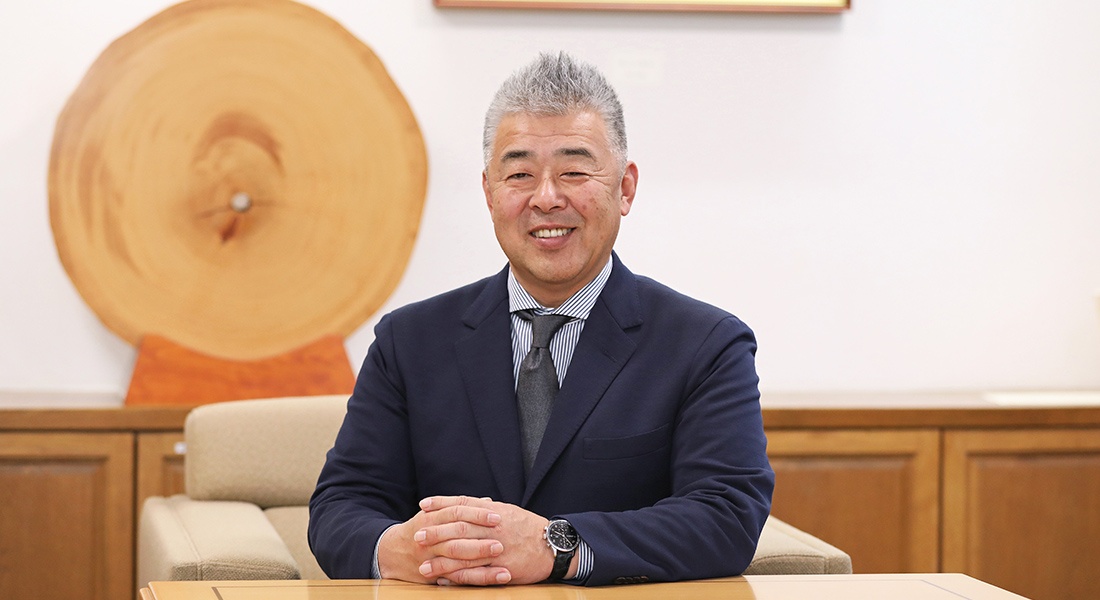
23 Feb Interview with Mr. Hidehiro Tsukakoshi, President of Ina Food Industry
Ina Food Industry operates across a diverse portfolio – how do you balance these activities while maintaining a unified corporate identity and long-term strategy?
Tsukakoshi: Our main business is producing agar and related products. About 60% of our sales come from commercial products, mainly serving food manufacturers. Our product development begins with our sales team visiting customers to understand their needs, after which we create products to meet those demands.
Household products account for about 20% of our sales. Unlike commercial products, these are sold directly to consumers through e-commerce rather than supermarkets. Our approach is unique: we develop products that we, as consumers, genuinely want to buy. We believe this reflects the desires of many customers, making the products easier to sell.
Farming and sake brewing are smaller parts of our business, but they are important to our core operations. Understanding agriculture helps us improve our food products, while sake brewing preserves Japanese culture and deepens our appreciation of traditional craftsmanship. These activities complement our main business and reflect our commitment to quality and culture.
How does Ina Food Industry’s innovation in agar products respond to evolving consumer expectations in Japan and internationally?
Tsukakoshi: The main function of agar is to create jelly and add viscosity to foods, and it is commonly used in desserts in Japan. Importantly, agar is not considered a food additive here because it has more than 400 years of history in Japanese cuisine. This distinction is a key point for our customers and for food manufacturers.
How do sustainability and environmental practices shape operations across Ina Food Industry’s portfolio, including Hama Gardening and Papana Farm?
Tsukakoshi: Our main business is agar production, which is made from seaweed. The seaweed residue is now 100% recycled into fertilizer for our farming operations, making our production fully sustainable.
Papana Farm is central to our philosophy. In Japan, where the population is aging and the workforce is shrinking, continuing agricultural operations is increasingly challenging. For us, sustainability means enduring over the long term rather than pursuing rapid growth. We follow what we call “tree ring management”—growing slowly and steadily like a tree, building strength and resilience instead of chasing short-term profits.
How does your partnership with Aqua Theon support long-term growth, regional development, and global sustainability objectives?
Tsukakoshi: We are based in Japan, so we were not very familiar with the U.S. market. Alissa Miky, President of Aqua Theon, is Japanese but based in the United States, and she understands the market and food manufacturers there very well. Her passion for introducing agar and its health benefits to the U.S. impressed us, which led us to form this partnership.
Seaweed is the raw material for agar and a natural resource, so we do not aim for rapid expansion or quick sales. Following our “tree ring management” philosophy, we intend to grow the market slowly and sustainably. In the long term, we hope to make agar more widely known in the U.S. and contribute to people’s health worldwide.
Do you see opportunities to expand in the U.S. beyond agar, perhaps with household products or sake brewing?
Tsukakoshi: We see great potential for Japanese sake in the U.S., but we intend to expand gradually. A similar pattern occurred with Japanese matcha, which grew very quickly in the U.S., leading to shortages and rising prices that ultimately harmed farmers. We want to avoid repeating that situation and instead grow our sake business steadily.
As for household products, differences between U.S. and Japanese food regulations currently make exports difficult, so we do not have plans to expand those products into the U.S. market at this time.
What is your final message for our readers of USA Today?
Tsukakoshi: We believe the 20th-century model of producing and selling as much as possible is no longer sustainable. Today, manufacturers should focus on creating high-quality products and growing steadily over the long term. Rapid trends—such as matcha in the U.S.—may generate short-term popularity, but they can also harm producers. With our sake, we aim to build a lasting culture rather than simply sell products, and to expand steadily within the U.S. market.
Sorry, the comment form is closed at this time.